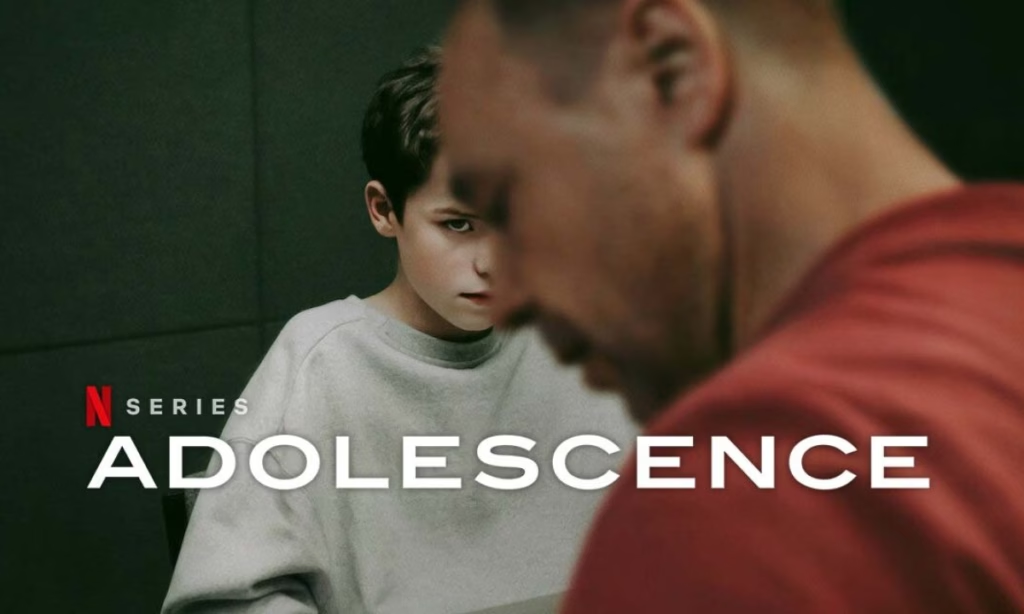
Adolescence is one of those dramas where the way it is filmed matters almost as much as the story. Netflix’s four-part limited series follows a family after 13-year-old Jamie Miller is arrested on suspicion of murdering a classmate, while every episode unfolds in one continuous take.
This page is the spoiler-light companion to my personal review, bringing the cast, story, themes and the behind-the-scenes filming technique together in one place.
What Is Adolescence About?
The Miller family’s ordinary life is shattered when police arrest 13-year-old Jamie. Rather than turning the story into a straightforward whodunnit, the series looks at the people around him: his parents, the detectives, his school and the psychologist trying to understand what has happened.
The drama was co-created and written by Stephen Graham and Jack Thorne, with Philip Barantini directing.
Main Cast
- Owen Cooper — Jamie Miller
- Stephen Graham — Eddie Miller, Jamie’s father
- Christine Tremarco — Manda Miller, Jamie’s mother
- Ashley Walters — DI Luke Bascombe
- Erin Doherty — Briony Ariston, the clinical psychologist assigned to Jamie
- Faye Marsay — DS Misha Frank
Why the One-Take Filming Is Such a Big Deal
Each episode is filmed as a single continuous shot. There are no normal edits cutting between close-ups, reaction shots or different camera positions. Once a take begins, the cast, camera operators and crew all have to keep moving together until the episode is complete.
Director of photography Matthew Lewis described the process as one camera moving through the space with no cuts — what is filmed becomes the episode. That changes everything from blocking and lighting to acting, focus pulling and how crew members move out of the camera’s path.
How Adolescence Was Filmed
- The camera tracks characters through homes, police spaces, schools and outdoor locations without conventional edits.
- Actors have to sustain performances in real time rather than building a scene from multiple takes and angles.
- Lighting, sound, extras and camera movement have to be choreographed around the action.
- Episode 2 involved around 300 children plus teachers and chaperones, making rehearsal and timing especially important.
- The production spent weeks rehearsing each episode before filming full takes.
What the Technique Does to the Audience
The continuous shot removes the usual breathing space created by editing. Awkward silences last. Arguments cannot be escaped by cutting away. The viewer stays physically close to the characters, which makes the tension feel more immediate and sometimes uncomfortably intimate.
It can also make the series feel closer to live theatre: once the scene starts, everyone has to keep going. Ashley Walters has described the process as feeling more like being in a theatre space than a normal television set, which is a useful way of thinking about the performance style.
Themes in Adolescence
The series explores youth violence, masculinity, online influence, rejection, family guilt, parenting, school culture and the ways teenage identity can be shaped by social media and peer pressure.
It is not based on one specific true case. Stephen Graham has explained that the idea grew from hearing repeated news reports involving young boys and knife crime, leading the creative team to ask wider questions about male rage and what young people are absorbing from the world around them.
School Curriculum & Media Studies Connections
Adolescence is particularly useful as a Media Studies case study because form and meaning are so closely connected.
- Cinematography: tracking shots, framing, proximity and camera movement.
- Editing: what changes when a drama deliberately removes conventional cuts?
- Mise-en-scène: how locations, lighting, costume and performance create realism.
- Representation: teenagers, masculinity, family, school and online culture.
- Audience: how the continuous take creates tension and forces viewers to stay with uncomfortable moments.
- Production: rehearsal, choreography and the practical challenges of filming long takes.
- Drama: sustained performance, blocking, ensemble timing and the similarity to live theatre.
Studying theatre, film or creative subjects? Visit Education & Creative Futures for more school curriculum and creative-industry connections.
My Personal Review
I’ve kept my spoiler-filled reaction separate from this guide because the ending and Jamie’s behaviour deserve room to discuss properly. Read my Adolescence Netflix review: Why It Left Me in Tears.
Where to Watch
Adolescence is a four-part Netflix limited series. Streaming availability can vary by region, so check Netflix for current access.
Frequently Asked Questions
Is every episode of Adolescence filmed in one take?
Yes. Each of the four episodes is filmed and presented as one continuous take without conventional cuts.
Who plays Jamie Miller?
Owen Cooper plays 13-year-old Jamie Miller.
Who created Adolescence?
The series was co-created and written by Stephen Graham and Jack Thorne, and directed by Philip Barantini.
Is Adolescence based on a true story?
No. Jamie Miller is fictional, although Stephen Graham has said the idea was prompted by news reports involving young boys and knife crime.
Why is Adolescence useful for Media Studies?
It is a strong case study for cinematography, long-take production, performance, representation, audience response and the relationship between technical choices and meaning.
More Film, TV & Adaptations
-

Dr Seuss’s How The Grinch Stole Christmas! The Musical Leeds 2026 – Cast, Tickets & Dates
Dr Seuss’s How The Grinch Stole Christmas! The Musical comes to Leeds Playhouse for Christmas 2026. Full cast, dates, tickets, access performances and practical information.
-
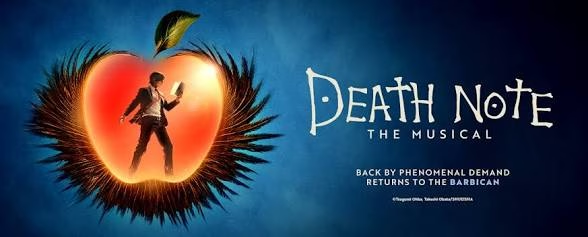
Death Note: The Musical Returns to London in 2027 – Barbican Dates & Tickets
Death Note: The Musical returns to London’s Barbican from 23 March to 15 May 2027. See dates, tickets, access performances, age guidance and what is confirmed so far.
-

City of Ghosts Canterbury 2026: Ghost Story Festival, M. R. James & Dark History
City of Ghosts comes to Canterbury on 3 October 2026 with M. R. James, live ghost stories, folklore, rare archive material and Gothic literary history.
-
The Cat in the Hat Afternoon Tea Bus London 2026 — Family Guide
The Cat in the Hat Afternoon Tea Bus London 2026 guide with dates, prices, age guidance, Christmas lights and practical family information.
-
Paddington Christmas Lights Bus London 2026 — Family Guide
Paddington Christmas Lights Bus London 2026 guide with dates, prices, festive route, afternoon tea and practical family information.
-
A Raisin in the Sun on Digital Theatre+: Streaming Guide
Streaming and education guide to A Raisin in the Sun on Digital Theatre+, including cast, production background and classroom resources.